
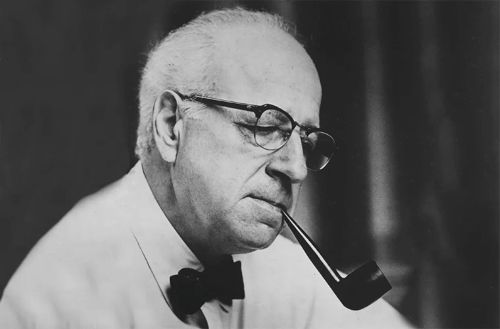
Born in Rockland, ME, 20 Jan 1894
Died in Belmont, MA, 12 Nov 1976
- Walter Piston was a self-taught musician. As a young adult, he earned money playing piano and violin in dance bands, orchestras, and chamber ensembles in Massachusetts.
- When the U.S. joined WWI, Piston quickly taught himself the saxophone so he could join the Navy Band.
- Following the war, Piston pursued music studies at Harvard, then spent a period at the École Normale de Musique in Paris, where he studied with Paul Dukas, Nadia Boulanger, and George Enescu.
- Piston returned to Boston in 1926 and joined the music faculty at Harvard, a position he maintained until 1960. He spent summers composing.
- As an educator, Piston wrote several significant textbooks: Principles of Harmonic Analysis (1933), Harmony (1941), Counterpoint (1947), and Orchestration (1955).
- Leonard Bernstein, Elliott Carter, and Leroy Anderson were among his students.
- As a composer, Piston’s earlier works were largely neoclassical. Later on, he explored more complex harmonies as well as serialism (within a tonal context).
- He had a close, collaborative relationship with Serge Koussevitzky at BSO and wrote many orchestral works for the ensemble.
- Among MANY other accolades, Piston won two Pulitzer Prizes: one for Symphony No. 3 and one for Symphony No. 7.1
Learn More
Bio via Atlanta Symphony Orchestra
Bio via American Symphony Orchestra
Sources
- Howard Pollack, “Piston, Walter,” Grove Music Online (2001), accessed May 13, 2026, https://www.oxfordmusiconline.com/grovemusic/view/10.1093/gmo/9781561592630.001.0001/omo-9781561592630-e-0000021851.