
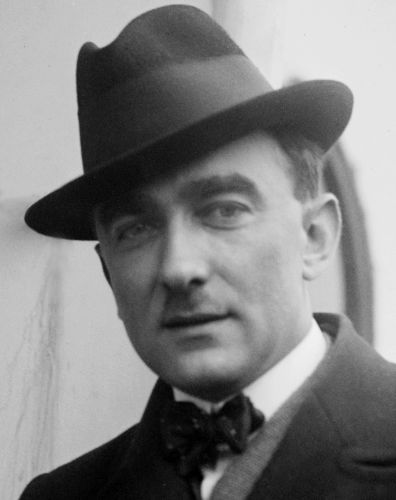
Born in Tymoszówka (formerly part of the Russian Empire; now part of Ukraine), near Kyiv, Oct 3, 1882
Died in Lausanne, March 29, 1937
- Karol Szymanowski [KAH-roll shee-mah-NOF-skee | pronunciation] began his musical education at an early age, encouraged by his family.
- Szymanowski moved to Warsaw in 1901 to study composition. Within a few years, he became affiliated with the Young Poland movement, which sought to modernize Polish culture (music, literature, etc.) and connect with broader European trends.
- As a composer, Szymanowski’s music falls into four periods: early career (1905-1913), WWI (1914-1917), 1920s, and 1930s.
- During his early career, Szymanowski’s music was strongly influenced by German Romanticism, including Richard Strauss and Richard Wagner.
- During WWI, Szymanowski returned home to Tymoszówka and had the most prolific compositional period of his life. Influences during this period include Debussy and Ravel, as well as Mediterranean and Arab cultures.
- This period came to a sudden halt at the outbreak of the October Revolution and the consequent destruction of his family home.
- During the 1920s, after returning to Warsaw, Szymanowski was inspired to create a Polish national style in his music after Poland became an independent state.
- In the last years of his life, Szymanowski retreated somewhat from Polish folk music in his works, and writing became increasingly difficult as his health declined.1
Learn More
Short bio via the Seattle Chamber Music Society
Bio via USC’s Polish Music Center
Sources
- Jim Samson, “Szymanowski, Karol,” Grove Music Online (2001), accessed September 28, 2026, https://www.oxfordmusiconline.com/grovemusic/view/10.1093/gmo/9781561592630.001.0001/omo-9781561592630-e-0000027328.