
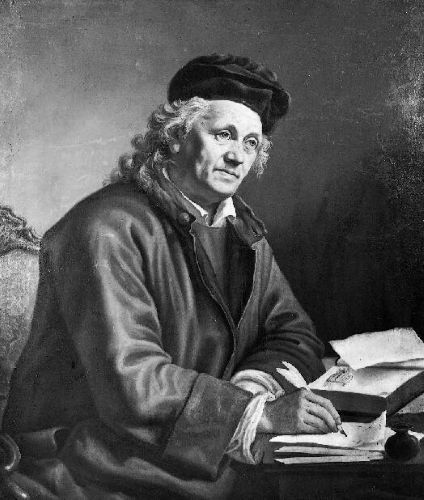
Born in Saalfeld, bap. April 24, 1721
Died in Berlin, 26 or July 27, 1783
- Kirnberger’s legacy lies largely in his work as a music theorist, and his contemporaries widely considered his writings on the subject invaluable.
- Like most composers of the time, Kirnberger earned a living working for noble and wealthy patrons. These various positions culminated in 1758, when he was appointed as music director for Princess Anna Amalia of Prussia (sister of Frederick the Great). He remained in this role until his death.
- Nearly all of Kirnberger’s published compositions were written during his service to Princess Anna Amalia. These included works for solo keyboard, chamber ensemble, and solo voice.1
- In his late teens, Kirnberger went to Leipzig to study composition and performance with J. S. Bach for two years.
- Kirnberger considered J. S. Bach to be the greatest of all composers, which, interestingly, was not the general sentiment at the time. During Kirnberger’s lifetime, people saw Bach as old-fashioned. Kirnberger developed musical theories that perpetuated Bach’s compositional methods so that future generations would continue to appreciate his works. Kirnberger also helped publish Bach’s unpublished chorale preludes.2
- *A note on the musical era(s) Kirnberger belonged to: while Kirnberger lived and worked during the transition between Baroque and Classical eras, his music was deeply rooted in Baroque traditions and harmony, so he is considered to be a “Baroque” composer.
Learn More
Biography via Bach Cantatas website
Sources
- Howard Serwer, “Kirnberger [Kernberg], Johann Philipp,” Grove Music Online (2001), accessed September 8, 2026, https://www.oxfordmusiconline.com/grovemusic/view/10.1093/gmo/9781561592630.001.0001/omo-9781561592630-e-0000015061.
- “Johann Philipp Kirnberger (Composer, Music Theorist, Violin, Copyist, Bach’s Pupil),” Bach Cantatas, accessed September 8, 2026, https://www.bach-cantatas.com/Lib/Kirnberger-Johann-Philipp.htm.